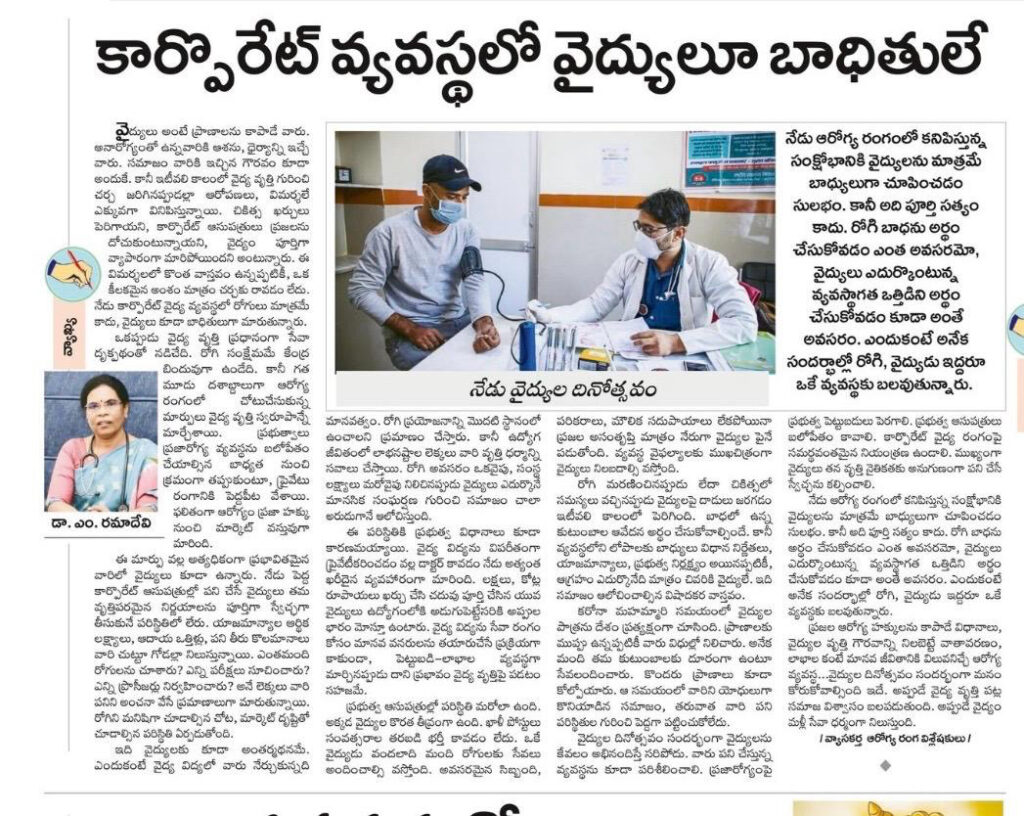
Doctors Too Are Victims in the Corporate Healthcare System
By Dr. M. Rama Devi
Doctors are people who save lives. They give hope and confidence to those suffering from illness. That is why society has traditionally held doctors in high esteem.
However, in recent years, whenever healthcare is discussed, the conversation is dominated by allegations and criticism. People say that treatment has become expensive, corporate hospitals exploit patients, and healthcare has become a business. While some of these criticisms are valid, one important aspect is often ignored: today, doctors themselves have become victims of the corporate healthcare system.
Healthcare has changed dramatically
In the past, medical practice was primarily service-oriented, with the patient’s welfare at its center. Over the last three decades, however, major changes in the healthcare sector have transformed the nature of medical practice.
Governments have gradually withdrawn from their responsibility of strengthening public healthcare and increasingly encouraged the private sector. As a result, healthcare has shifted from being a public right to becoming a market commodity.
Corporate hospitals measure doctors by business targets
Doctors working in large corporate hospitals often face enormous pressure.
Their performance is evaluated by questions such as:
- How many patients did they see?
- How many diagnostic tests did they prescribe?
- How many procedures did they perform?
These business metrics have become the standards for evaluating doctors, instead of the quality of patient care.
Instead of treating patients as human beings, doctors are increasingly expected to look at them through a commercial lens.
Doctors experience moral conflict
During medical education, doctors take an oath to place the patient’s welfare first.
But in corporate employment, financial targets and profit calculations frequently conflict with professional ethics.
Doctors often face difficult situations where the needs of the patient and the financial goals of the hospital are at odds.
Society rarely recognizes this psychological and ethical burden carried by doctors.
Privatization of medical education has worsened the problem
Government policies have also contributed.
Medical education has become heavily privatized, making it extremely expensive to become a doctor. Many students spend lakhs or even crores of rupees on their education.
When they begin their careers, they often carry huge debts.
When medical education itself becomes an investment aimed at financial returns rather than preparing professionals for public service, its impact on medical practice is inevitable.
Government hospitals face a different crisis
Government hospitals suffer from severe shortages of doctors.
Vacant posts remain unfilled for years.
One doctor may have to care for hundreds of patients every day.
Even when hospitals lack staff, equipment, medicines, and infrastructure, public dissatisfaction is directed mainly at doctors.
Doctors become the visible face of failures that are actually systemic.
Violence against doctors
Whenever a patient dies or complications occur, attacks on doctors have become increasingly common.
The grief of families is understandable.
However, although policy failures, poor administration, and government neglect are often the real causes, doctors are the ones who ultimately face public anger.
This is a tragic reality that society needs to acknowledge.
Lessons from COVID-19
During the COVID-19 pandemic, the country witnessed the dedication of doctors firsthand.
Despite risking their own lives, they continued working.
Many stayed away from their families for months.
Some even lost their lives while serving patients.
At that time, society celebrated them as heroes.
Yet afterward, little attention was given to improving their working conditions.
Doctors’ Day should be about reform
Doctors’ Day should not merely be an occasion to congratulate doctors.
It should also be a day to examine the healthcare system in which they work.
Government investment in public healthcare must increase.
Government hospitals must be strengthened.
Corporate healthcare requires effective regulation.
Most importantly, doctors should be allowed to practice medicine according to professional ethics rather than commercial pressures.
The real crisis
Blaming doctors alone for today’s healthcare crisis is easy.
But it is not the whole truth.
Understanding the suffering of patients is essential.
Equally important is understanding the systemic pressures faced by doctors.
In many situations, both patients and doctors are victims of the same healthcare system.
Conclusion
On Doctors’ Day, we should strive for:
- Strong public healthcare.
- Policies that protect people’s right to health.
- Respect and dignity for the medical profession.
- A healthcare system that values human life more than profits.
Only then will public trust in doctors grow stronger.
Leave a Reply